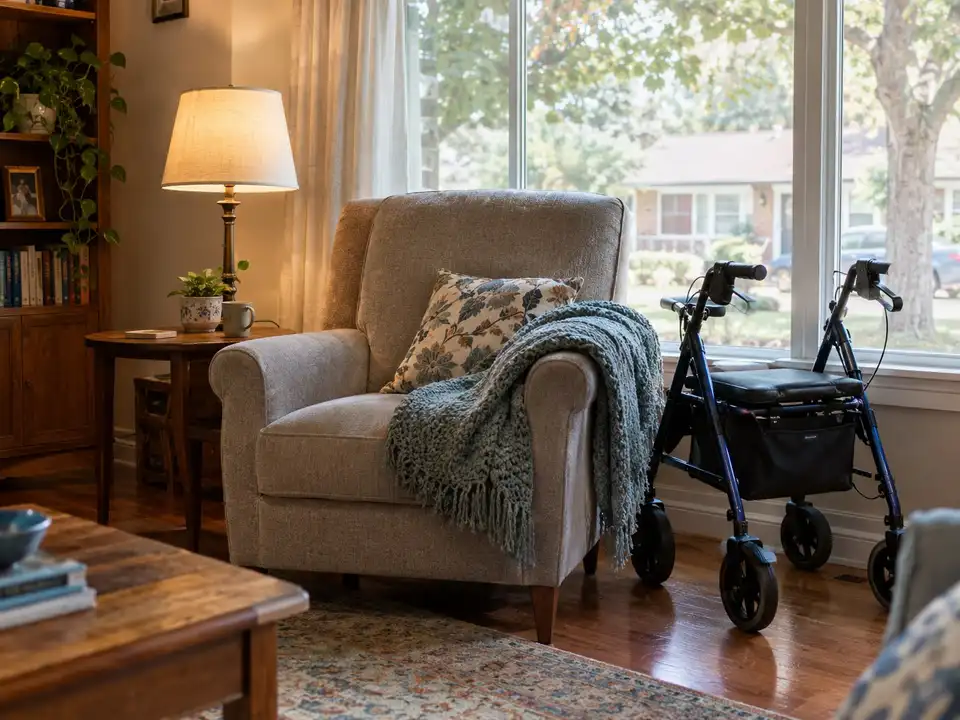
TorontoReverseMortgage.ca covers paying for home care in Toronto for homeowners 55 and older and their families. Families who ask about it usually want to keep a parent or spouse safely at home, with help coming in.
The challenge is not usually the first month’s bill. It is paying for the same care month after month, on a fixed income. Public home care helps, and private hours can fill the rest.
What happens after your free estimate
The free estimate form comes first. It asks your age, your home’s value and what you still owe, and it shows an estimate on screen. Getting an estimate doesn’t affect your credit.
Richard Hopkins, Mortgage Broker, then compares every reverse mortgage lender in Canada and sends your options and his recommendation by email. For home care, you’ll be asked roughly how many hours of care you pay for now, or expect to, because that sets the monthly deposit.
Often an adult child leads, with the parent copied on every email. Either way, the homeowner makes the decision, and calls by phone or video call can include the whole family.
Nothing is signed at this stage, and you can stop at any of the seven steps. The one meeting normally held in person is with your own lawyer. If travel to the office would be very hard for you, some lenders will agree to a video call.
What Ontario pays for, and what families pay for
Publicly funded home care is free if you qualify. The Ontario government pays for it, and Ontario Health atHome arranges it (Government of Ontario).
A care coordinator assesses your needs and sets your care plan, including the services and how many hours of personal support you receive. Families who want more hours, or help at set times, can pay a private company for the rest.
What private care costs in Toronto
Private personal support costs about $28 to $45 or more an hour in the Toronto area, according to a Toronto home-care agency’s May 2026 price guide (Arcadia Home Care). The same guide notes that Ontario publishes no official private rate. Most agencies ask for visits of at least three or four hours.
Ten hours a week at $35 an hour, a rate inside that range, comes to about $1,517 a month. Ask two or three agencies for written quotes before you choose.
A tax credit for people 70 and older
Ontario’s Seniors Care at Home Tax Credit returns 25% of up to $6,000 of eligible medical expenses a year, so up to $1,500. It is for people 70 or older, or with a spouse 70 or older, and it gets smaller once family net income passes $35,000 (Government of Ontario).
Attendant care is on its list of eligible expenses, with a certification required. The credit is refundable, so it is paid even if you owe no income tax.
Long-term care waits, and what happens to the mortgage
More than 50,000 people in Ontario were waiting for long-term care in March 2026. Half of the people entering long-term care wait at least 165 days, by Ontario Health figures reported in 2024 (Ontario Long Term Care Association, citing Ontario government data).
In Toronto, the City’s own ten long-term care homes have room for 2,619 residents. They had more than 7,500 applications on their waitlists on May 1, 2025 (City of Toronto). Care at home has to cover the wait.
If one spouse moves into care
Nothing is triggered while a borrower still lives in the home. When both spouses are on the mortgage and one moves into long-term care, the other stays, and the mortgage continues unchanged. A temporary hospital or rehabilitation stay doesn’t count as moving out.
The mortgage becomes due when the last borrower moves out for good. Families commonly have up to a year to sell or repay, and some lenders reduce or waive the early-repayment charge when the move is into long-term care. The long-term care guide explains the details.
An empty house brings one more Toronto rule: the Vacant Home Tax, 3% of the home’s assessed value. It has an exemption when the person who lived there has been in a hospital, long-term care or supportive care for at least six months of the year, for up to two years in a row (City of Toronto). The guide to the Vacant Home Tax and long-term care explains it.
Example: $1,500 a month from a $1,111,200 Toronto semi
Take an illustrative couple in a mortgage-free semi-detached house in Toronto: he is 83 and she is 80. The Toronto Regional Real Estate Board (TRREB) benchmark price for a semi-detached house in the City of Toronto was $1,111,200 in September 2026 (TRREB Market Watch, September 2026). With the younger spouse at 80, they could qualify for up to about 60% of the home’s value, about $667,000.
He needs help with bathing and dressing. Ontario Health atHome covers part of it, and they add 10 hours a week of private care at $35 an hour, about $1,517 a month. They take a first amount of $25,000, used for extra care in harder weeks, then $1,500 a month, which covers nearly all of the private care.
After 5 years they have received $115,000: the $25,000 plus $1,500 a month for 60 months. At 6.49% a year, the highest advertised five-year fixed rate on October 31, 2026, the balance would be about $141,000. If the house were still worth $1,111,200, about $970,000 of its value would still be theirs.
What it costs and how it is paid back
With monthly deposits, each deposit starts adding interest on the day it arrives. The lenders’ advertised five-year fixed rates were 6.23% to 6.49% when checked on October 31, 2026.
Expect about $2,000 to $3,500 in one-time costs: an appraisal (usually about $350), the lender’s set-up fee ($995 to $1,795, usually added to the mortgage) and your own lawyer for independent legal advice. Your lawyer’s fee is about $800 to $1,200 in Ontario, not the $300 to $500 that lender paperwork often shows. The Toronto cost guide explains each cost.
There are no required monthly mortgage payments. Interest is added to the balance and compounds twice a year, so the balance grows. Home price growth often makes up some or all of it, and Canadian borrowers keep about half of their home’s value on average.
The mortgage is repaid when the home is sold, when the last borrower moves out for good, or when the last borrower dies. Under the no negative equity guarantee, you or your estate never owe more than the home’s fair market value on the day the mortgage comes due, as long as property taxes, insurance and upkeep were kept up.
Repaying early brings a charge in the first years that shrinks over time, but there is no charge at any lender when the mortgage is repaid after the last borrower’s death. The Toronto reverse mortgage calculator shows how a balance could change over time.
Changes to the house can help too, and paying for aging in place renovations explains how.
What's included when you ask for help
- A free estimate that doesn't affect your credit
- Every reverse mortgage lender in Canada compared for your family
- The best deal for your home and your care plan, by email
- Monthly deposits planned around the care you pay for
- An adult child can lead, with the parent copied on every email
- A plain answer on what happens if one of you moves into care
- A free referral to an independent lawyer for your legal advice
- Told plainly when public help would cover what you need
Related guides
- What happens to a reverse mortgage if you move into long-term care in Toronto?
- Does Toronto's Vacant Home Tax apply when a parent moves into long-term care?
- How much does a reverse mortgage cost in Toronto?
Sources
Figures checked October 31, 2026.
- TRREB, Market Watch, September 2026 (MLS HPI benchmark prices, City of Toronto, p. 26)
- Government of Ontario, A Guide to Programs and Services for Seniors: support services at home and in the community (updated August 21, 2026)
- Arcadia Home Care, Home care costs in Ontario (a Toronto home-care agency's estimate, May 22, 2026)
- Government of Ontario, Ontario Seniors Care at Home Tax Credit
- Ontario Long Term Care Association, The Data (Ministry of Long-Term Care, March 2026; Ontario Health wait times)
- City of Toronto, Long-Term Care Annual Performance Report (June 5, 2025)
- City of Toronto, Vacant Home Tax