TorontoReverseMortgage.ca is a Toronto reverse mortgage information website that shows homeowners 55 and older how to pay for aging in place renovations. People who look into it usually want to stay in their own house, safely, for as long as they can.
The challenge is not usually knowing what to change. It is paying for the changes without taking on a new monthly payment. A reverse mortgage has no required monthly mortgage payments, and interest is charged only on the money you take.
What happens after your free estimate
The free estimate form comes first. It asks your age, your home’s value and what you still owe, and it shows an estimate on screen. Getting an estimate doesn’t affect your credit.
Richard Hopkins, Mortgage Broker, then compares every reverse mortgage lender in Canada and emails you the best deal for your home and the changes you need. For a renovation, you’ll be asked what you plan to change and whether a contractor has given you a written quote.
Your children can be copied on every email and join calls by phone or video call. Nothing is signed at this stage.
The whole process has seven steps, and you can stop at any of them. The one meeting normally held in person is near the end, with your own lawyer, for independent legal advice.
The changes that help people stay at home
Most aging in place renovations fall into four groups:
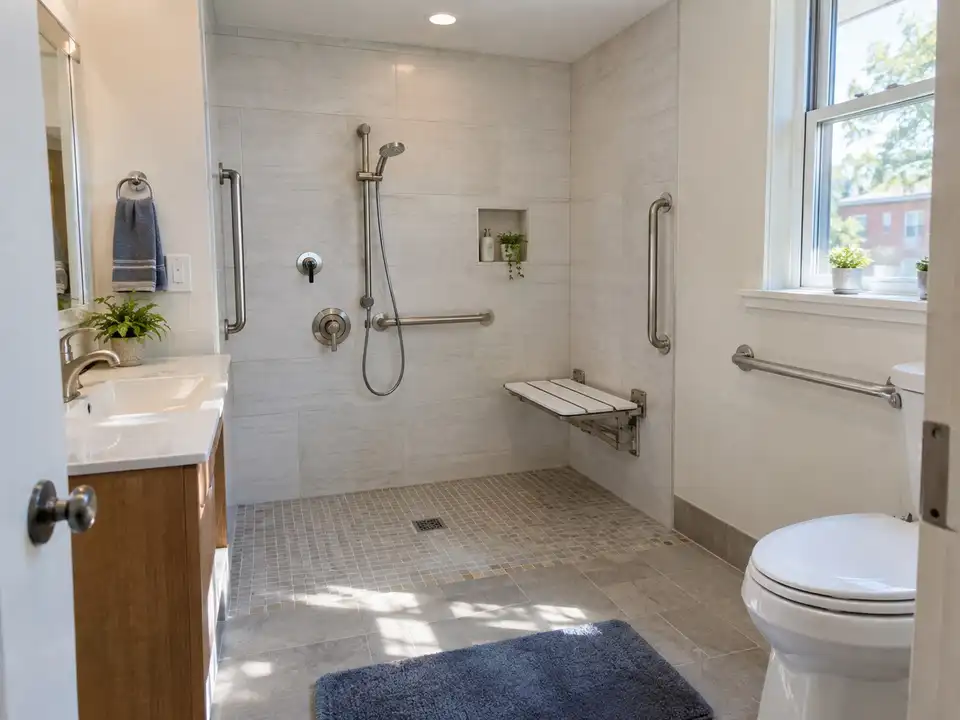
- Bathroom: a curbless walk-in shower, a fold-down seat, grab bars and non-slip tile.
- Stairs: a stair lift, or a second handrail.
- Main floor: a bedroom and bathroom on the main floor, so the stairs become optional.
- Entrances: a ramp, a wider door or a railing at the front steps.
Much of Toronto’s housing is old. Of the people living in the city’s detached houses, 45.7% live in one built before 1961 (City of Toronto Ward Profiles, 2021 Census).
Prices vary widely with the house and the layout. The number that matters is a written quote for your own home. Smaller changes can sometimes be paid for another way, and the guide to alternatives in Toronto explains when each option fits.
Toronto building permits
The City of Toronto requires a building permit for construction, additions and material alterations (City of Toronto). Its list includes adding or removing walls, new door or window openings, enlarging existing ones, porches, and decks more than 60 centimetres (24 inches) above the ground.
A main-floor bedroom or a wider bathroom door can involve exactly those changes. Ask your contractor to include any permit in the written quote and to confirm with Toronto Building before the renovation starts.
Your home’s condition is part of the approval
Every reverse mortgage includes an appraisal, and the appraiser looks at the home’s condition as well as its value. Both affect the approval.
When a repair is already booked with a contractor, a lender will sometimes build it into the mortgage with a holdback. Part of the money is held back and paid out once the repair is finished. A home in serious disrepair may need a short-term private mortgage first, which the reverse mortgage then replaces.
The amount you qualify for is not extra money on top of what you owe. Any mortgage or line of credit on the home is paid off first, from the same money. The Toronto reverse mortgage calculator shows the most your age and home value allow.
Example: renovating a $1,213,200 Etobicoke bungalow at 78
Take an illustrative widow, 78, in a 1960s bungalow in the Richview area of Etobicoke. The Toronto Regional Real Estate Board (TRREB) benchmark price for a detached house in that district (W09) was $1,213,200 in September 2026 (TRREB Market Watch, September 2026). At 78, she could qualify for up to about 60% of the home’s value, about $728,000.
She still owes $40,000 on a home equity line of credit, so that is paid off first, leaving up to about $693,000. She takes $60,000 more for a curbless walk-in shower, grab bars and a stair lift, based on her contractor’s written quote. Her balance starts at $100,000.
At 6.49% a year, the highest advertised five-year fixed rate on October 31, 2026, the $100,000 would grow to about $138,000 in 5 years and about $189,000 in 10. If the house were still worth $1,213,200 after 10 years, about $1,024,000 of its value would still be hers. She no longer makes line of credit payments.
Government help that can lower the cost
The federal Home Accessibility Tax Credit lets you claim up to $20,000 a year of eligible renovation costs if you are 65 or older, or eligible for the disability tax credit (Canada Revenue Agency). The renovation must help you get into the home or move around it, or lower the risk of harm there. Routine maintenance and appliances don’t count.
Ontario’s Home and Vehicle Modification Program helps Ontarians whose disability limits their mobility, with changes such as ramps, stair lifts, wider doors and rearranged bathrooms (Government of Ontario). Households with income over $38,000 may be asked to pay part of the cost. Applications go through March of Dimes Canada.
If you are 70 or older, Ontario’s Seniors Care at Home Tax Credit returns 25% of up to $6,000 of eligible medical expenses a year, so up to $1,500 (Government of Ontario). Bathroom aids such as grab bars and rails are on its list.
What it costs and how it is paid back
Renovation money is usually taken as one amount, so interest starts on all of it from day one. The lenders’ advertised five-year fixed rates were 6.23% to 6.49% when checked on October 31, 2026.
The one-time costs come to about $2,000 to $3,500: an appraisal (usually about $350), the lender’s set-up fee ($995 to $1,795, usually added to the mortgage) and your own lawyer for independent legal advice. In Ontario that lawyer costs about $800 to $1,200, not the $300 to $500 that lender paperwork often shows. Closing an existing mortgage or line of credit usually adds $300 to $400, and the Toronto cost guide explains each cost.
There are no required monthly mortgage payments. Interest is added to the balance and compounds twice a year, so the balance grows. Home price growth often makes up some or all of it, and Canadian borrowers keep about half of their home’s value on average.
Repayment comes when the home is sold, when the last borrower moves out for good, or when the last borrower dies. Under the no negative equity guarantee, you or your estate never owe more than the home’s fair market value on the day the mortgage comes due, as long as property taxes, insurance and upkeep were kept up.
Repaying early brings a charge in the first years, and it shrinks over time. Some lenders let you repay up to 10% a year without one. If a move into care comes later, the long-term care guide explains what happens to the mortgage, and paying for care at home covers the years before that.
What's included when you ask for help
- A free estimate that doesn't affect your credit
- Every reverse mortgage lender in Canada compared for your home
- The best deal for your home and your renovation, by email
- An amount planned around your contractor's written quote
- Advice on a holdback when a repair is already booked
- Help arranging the appraisal of your home
- Your children copied on every email, if you wish
- A free referral to an independent lawyer for your legal advice
Related guides
- How much does a reverse mortgage cost in Toronto?
- What are the alternatives to a reverse mortgage in Toronto?
- What happens to a reverse mortgage if you move into long-term care in Toronto?
Sources
Figures checked October 31, 2026.
- TRREB, Market Watch, September 2026 (MLS HPI benchmark prices, district W09, p. 26)
- City of Toronto, 2023 Ward Profiles, 2021 Census (single-detached residents by period of construction)
- City of Toronto, Building Permits: when a permit is required
- Canada Revenue Agency, Line 31285: Home accessibility expenses
- Government of Ontario, Home and Vehicle Modification Program (updated September 1, 2026)
- Government of Ontario, Ontario Seniors Care at Home Tax Credit