TorontoReverseMortgage.ca explains how a reverse mortgage in Old Toronto works for homeowners 55 and older. Old Toronto is the former City of Toronto, which merged with its five neighbours in 1998. It covers downtown, midtown and the older east and west end neighbourhoods.
Homes here range from Victorian row houses to downtown condos and midtown houses worth millions. The rules are the same across downtown and midtown Toronto, but the amount you could borrow changes a great deal from one district to the next.
Old Toronto’s homes and what they mean for a reverse mortgage
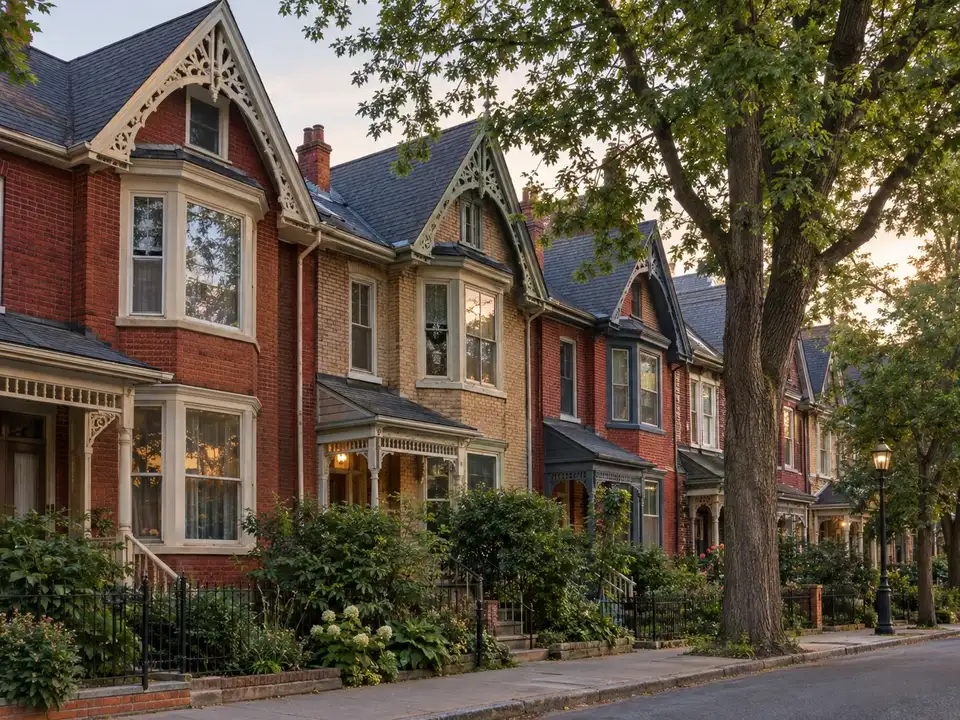
Much of Old Toronto’s older housing is Victorian and Edwardian, including long rows of semi-detached and row houses on deep, narrow lots.
In Cabbagetown Southwest, the City’s heritage research found most buildings date from 1870 to 1900, many with the bay-and-gable front: a tall bay window under a pointed gable (City of Toronto).
Older houses are common across the central wards. In Ward 11 (University-Rosedale), 76% of people in detached houses live in one built before 1946, and in Ward 4 (Parkdale-High Park) the figure is 81% (City of Toronto Ward Profiles, 2021 Census).
Only about 9.7% of Old Toronto’s homes were single-detached houses in 2021, and 42.9% of households owned their home, the lowest of Toronto’s six former cities. Both figures group the City’s neighbourhood profiles by the old borders, so treat them as close estimates (City of Toronto Neighbourhood Profiles, 2021 Census).
The price gap inside Old Toronto is wide. Downtown, TRREB’s September 2026 benchmark for a condo apartment (its price for a typical unit) was $550,600 in C01 and $497,900 in C08.
In midtown’s C09, Rosedale-Moore Park, the benchmark detached house was $3,407,500, almost seven times the C08 condo (TRREB Market Watch, September 2026).
That gap matters because the most you can borrow is a percentage of the appraised value. Condos qualify with every Canadian reverse mortgage lender, but a reverse mortgage on a Toronto condo also depends on the building and its condo corporation. Leasehold condos and co-ops don’t qualify with any lender.
Who asks about reverse mortgages in Old Toronto
Old Toronto is the youngest of the six former cities, with about 13.9% of residents aged 65 or older in 2021 (a close estimate on the same basis). Downtown Ward 10 (Spadina-Fort York) was only 7.8% (City of Toronto Ward Profiles, 2021 Census).
Midtown neighbourhoods are among the oldest in Toronto. In 2021, 27.9% of Rosedale-Moore Park residents were 65 or older, along with 25.7% in Casa Loma and 25.5% in Yonge-St. Clair.
Only 36.8% of Rosedale-Moore Park owners had a mortgage, and owners there estimated their homes at $2.66 million on average (City of Toronto Neighbourhood Profiles, 2021 Census).
The reasons to ask differ by home. A midtown owner may want to give a child a living inheritance toward a first home, or pay for care at home without selling.
A Victorian semi may need a roof, brick repairs or new wiring. A downtown condo owner on a fixed income may want monthly deposits to cover condo fees and daily costs.
A worked example: a Victorian house in Old Toronto at $1,382,900
For example, an illustrative widower, aged 82, owns a detached Victorian house in Riverdale with no mortgage left. It is valued at $1,382,900, TRREB’s September 2026 detached benchmark for E01, the district that includes Riverdale. At 78 and older, the ceiling is up to about 60% of the value, or about $829,700.
He takes $50,000 now to pay for help at home a few days a week and a stair lift. The other $779,700 or so stays untouched, and interest is charged only on the $50,000 he took. If he needs more care later, he can ask for another advance, which may have a different rate or a small fee, depending on the lender.
He has no required monthly mortgage payments, but his property taxes, home insurance and upkeep are still his to pay. His balance grows as interest is added, and what’s typically called the no negative equity guarantee means he or his estate never owes more than the home’s fair market value on the day the mortgage comes due, as long as taxes, insurance and upkeep are kept up.
What a high-value home changes
The dollar amounts grow with the value, because the ceiling is a percentage. At 80, up to about 60% of a house at C09’s $3,407,500 benchmark is about $2,044,500, while the same percentage of a C08 condo at $497,900 is about $298,700. These are ceilings rather than quotes.
The market’s top tier reaches up to 60% for borrowers 70 and older. Products at that tier charge a higher interest rate on the entire balance, not only on the extra amount. Age 70 is where that choice starts; see how much a 70-year-old can borrow in Toronto.
You never have to take the maximum. Interest is charged only on money you actually take, and if the amount you need fits inside the standard range, you can avoid the top tier’s higher rate.
Richard Hopkins, Mortgage Broker, compares every reverse mortgage lender in Canada and emails you the best deal for this house and your goals.
Old Toronto neighbourhoods and landmarks
Help is the same in every part of Old Toronto. These are some of the neighbourhoods and places it covers.
- Cabbagetown
- St. Lawrence
- Trinity-Bellwoods
- The Annex
- Rosedale-Moore Park
- Forest Hill
- Yonge-Eglinton
- Roncesvalles
- Riverdale
- The Beaches
Landmarks
- CN Tower
- Toronto City Hall and Nathan Phillips Square
- Union Station
- Royal Ontario Museum
- Kensington Market
- Exhibition Place
- High Park
- Toronto Islands
How the help reaches you in Old Toronto
Richard Hopkins, Mortgage Broker, helps Old Toronto homeowners by email, phone and video call, and your family can be copied on every email. An appraiser visits the home, whether it is a Cabbagetown row house or a condo near Union Station. For the in-person appointment with your own lawyer, Lines 1 and 2 cross downtown, and Line 5 Eglinton stops across midtown from Cedarvale to Mount Pleasant.
What Old Toronto homes are worth right now
TRREB's September 2026 benchmarks (its prices for a typical home) put a condo apartment at $550,600 in C01 and $497,900 in C08, and a detached house anywhere from $1,382,900 in E01 (Riverdale and Leslieville) to $3,407,500 in C09 (Rosedale-Moore Park). At 65, up to 50.55% of the value means about $251,700 on a C08 condo apartment and about $1,722,500 on a C09 house; at 75, up to 57.75% means about $287,500 and about $1,967,800. These are ceilings rather than quotes, and the appraisal sets your home's value.
Source: TRREB Market Watch, September 2026 (MLS® Home Price Index benchmarks)
How Old Toronto homeowners use a reverse mortgage
- Reverse mortgages on Toronto condos: Every lender accepts a standard condo, but each one also reviews your building, so the same Toronto unit can get different answers.
- Helping your children buy a home: Give part of an inheritance now, while you can see it help, and keep living in your own home.
- Paying for care at home: Public home care is free if you qualify, and monthly deposits from your home's value can pay for the extra hours.
- Renovations to stay at home: A walk-in shower, grab bars or a stair lift, paid for from your home's value so you can stay where you are.
- Buying a condo with a reverse mortgage: A reverse mortgage can pay part of the price of your next Toronto condo, so more of your house sale stays in the bank.